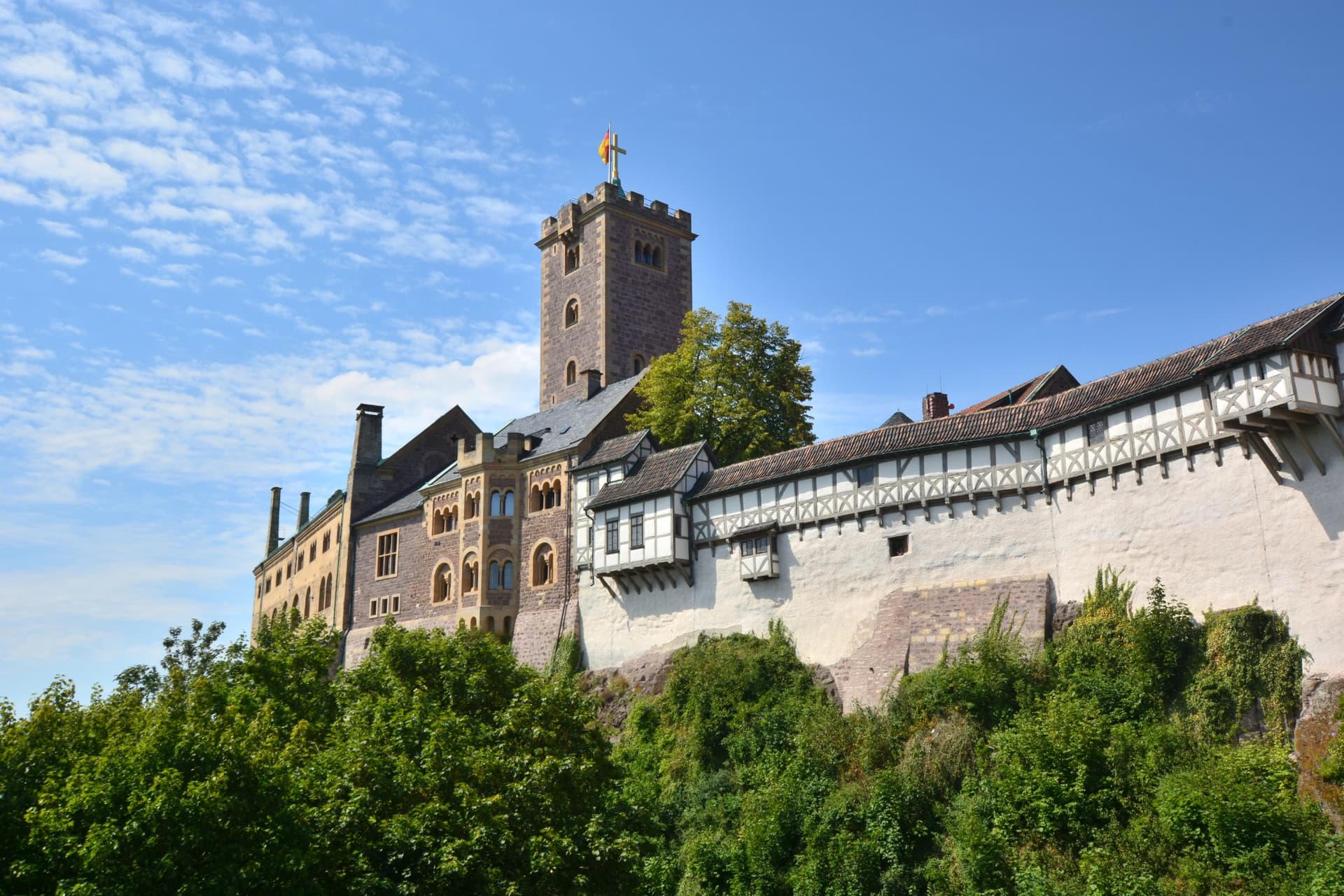
 Protected residence & translation
Wartburg Castle
A refuge that became a workshop for words.
Martin Luther
Castles offered a reformer protection, brought religious rivals to the same table and gave new beliefs a place in everyday worship.
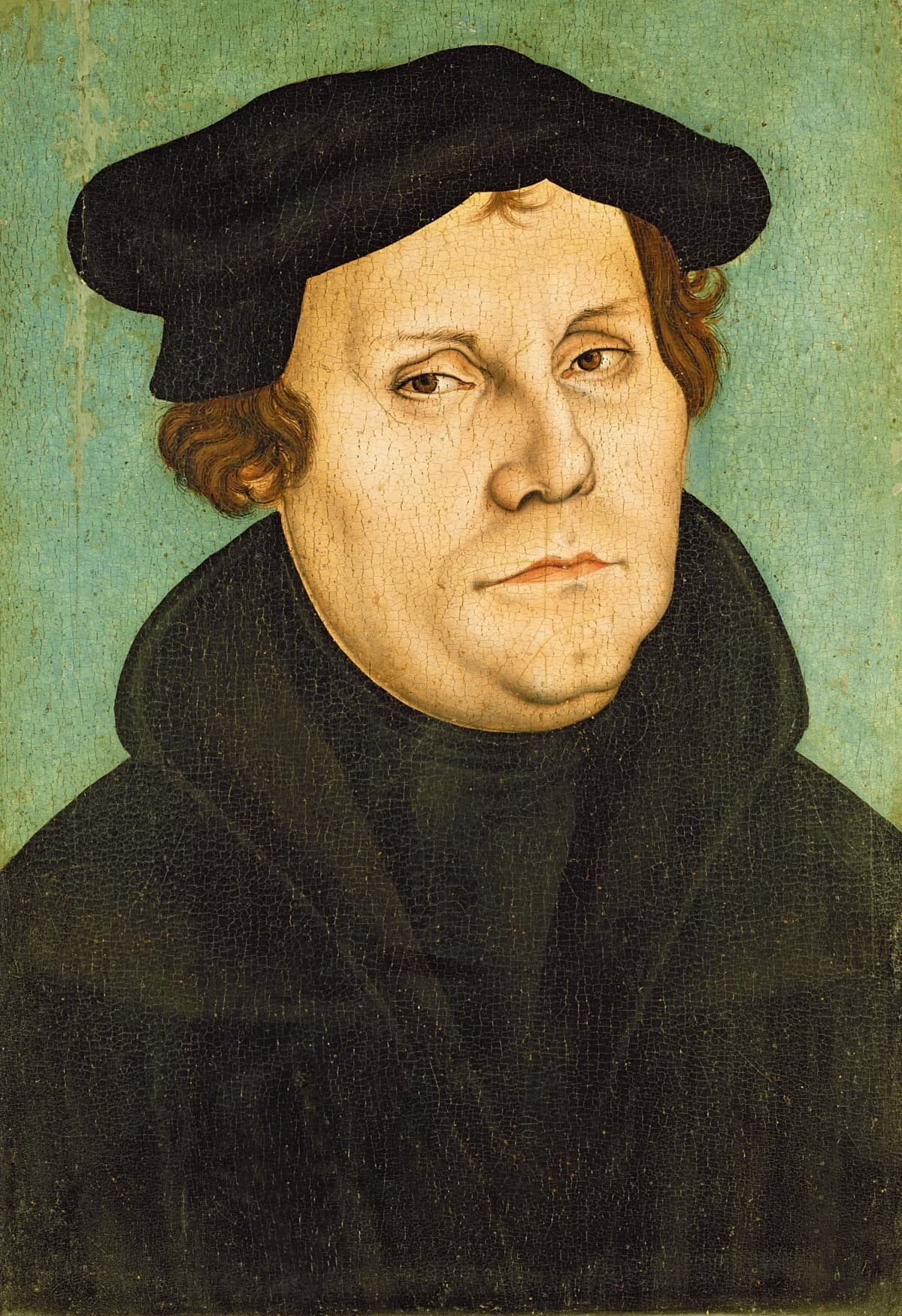
In 1521, a man living at the Wartburg under the name Junker Jörg was working on words that would travel far beyond its walls. He was Martin Luther. Protection had limited his movements, yet it also gave him a place to translate the New Testament.
16th-century Reformation
Born in Eisleben on 10 November 1483, Luther came from a family whose prospects were connected to the mining region around Mansfeld. After university study and the beginning of legal training, he entered the Augustinian order in 1505. In 1512 he received his doctorate in theology in Wittenberg.
His religious concerns reached beyond criticism of indulgences. At their centre was how human beings could be accepted by God: through grace and faith rather than earned merit. Theological argument became entangled with printing, political protection and changes to church institutions.
M1M2M3In 1517, Luther sent criticism of indulgence practices to church authorities. His theses circulated through scholarly contacts and print, reaching beyond an internal theological debate. The spread of the text matters as much as the famous image of a man at a church door.
Whether he personally nailed the Ninety-five Theses to the Castle Church in Wittenberg on 31 October remains debated. The scene is an influential tradition, not a licence to invent its sounds, audience or dialogue.
M4M5At the Wartburg in 1521–1522, Luther lived under the protection of Elector Frederick the Wise. His assumed identity offered safety, while separation from public life brought loneliness and physical and emotional difficulties.
In late 1521 and early 1522 he translated the New Testament from Greek. Publication followed in September 1522 after further work. He was not the first to translate the Bible into German, nor did he translate the entire Bible at the Wartburg. The complete edition of 1534 depended on sustained collaboration.
M7M8In 1529, Landgrave Philip of Hesse brought Luther, Huldrych Zwingli and other reformers to Marburg Castle to seek religious agreement and stronger political cooperation. A central dispute concerned Christ’s presence in the Lord’s Supper.
The fifteen Marburg Articles record both common ground and its limit. Fourteen articles express agreement; the fifteenth retains the Eucharistic disagreement. The meeting was neither a simple failure nor a unification of Protestantism. Later paintings of the encounter also cannot establish the exact room, seating or gestures.
M9M11During the Diet of Augsburg in 1530, Luther stayed at the Veste Coburg rather than joining the proceedings himself. From this protected setting he corresponded with Philipp Melanchthon and continued theological work. Being absent did not mean being uninvolved.
On 5 October 1544, he preached at the opening of the new chapel at Hartenfels Palace. The story moves from controversy and refuge to the use of a physical space for worship: reform was becoming part of everyday institutions.
M12M13Luther’s challenge to religious authority did not amount to a modern commitment to universal freedom. When peasants used reforming language to press social demands, he rejected rebellion against the established political order.
His anti-Jewish writings of 1543 called for persecution, including destruction of synagogues and homes. These positions belong in his biography, alongside his religious and literary influence. A historical account must acknowledge their harm without reducing several centuries of later history to a single automatic chain of causation.
M14M15CHRONOLOGY
Born in Eisleben.
Enters the order; later receives his theology doctorate.
The indulgence controversy and circulation of the theses.
Protected residence and New Testament translation at the Wartburg.
Religious colloquy at Marburg Castle.
Correspondence and theological work from Veste Coburg.
Preaches at the opening of Hartenfels Palace chapel.
Dies in Eisleben.
PLACES & CONNECTIONS
Each connection has its own story. Building, finding refuge and facing a siege are very different relationships.
Protected residence & translationA refuge that became a workshop for words.
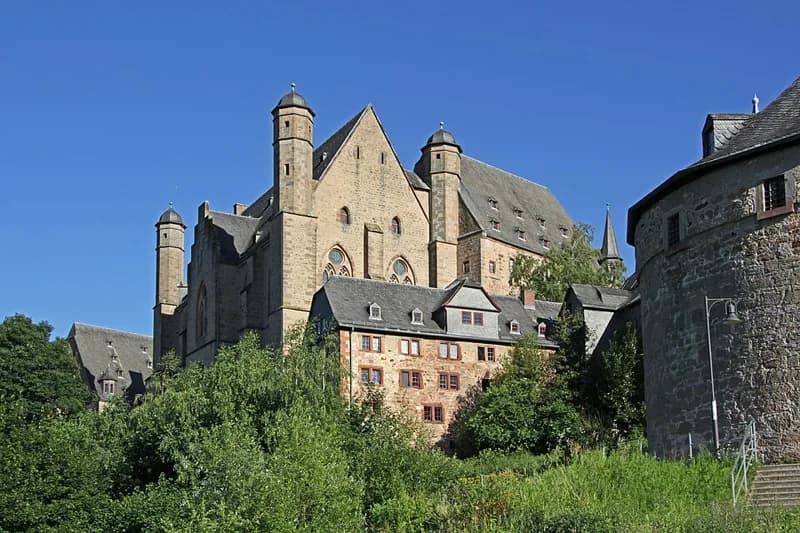 Religious colloquy
The shared convictions and unresolved differences of 1529.
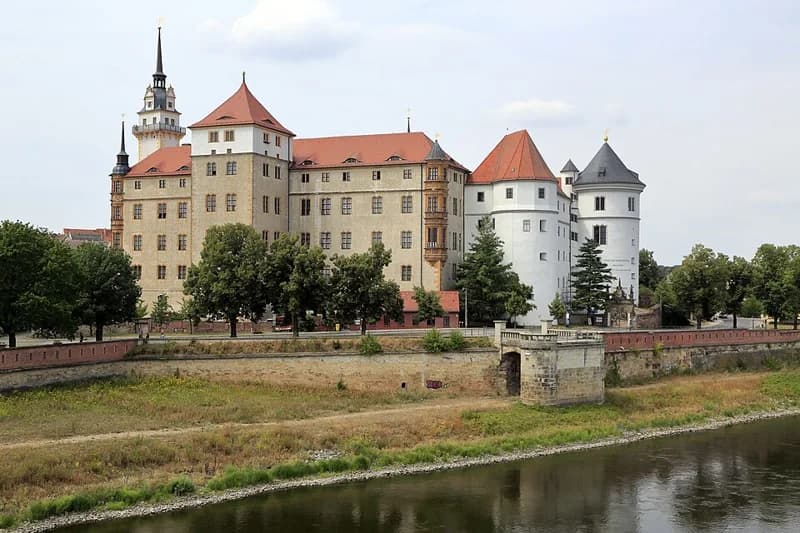 Chapel opening
A sermon in 1544 connects reform with a new worship space.
HISTORY & MEMORY
The story of Luther throwing an inkwell belongs to legend. Later marks and their repair reveal a history of remembrance, not proof of the encounter.
The Wartburg story concerns the New Testament. Earlier German translations existed, and the complete Bible involved other scholars.
His opposition to peasant rebellion and his anti-Jewish writings must remain visible in an account of his legacy.
Based on heritage institutions, museums, academic research and historical documents. Sources are attached to the relevant sections.
Editorial review · 27 October 2026
CONTINUE READING